

THE MESSAGE OF THE GARDEN OF WORDS
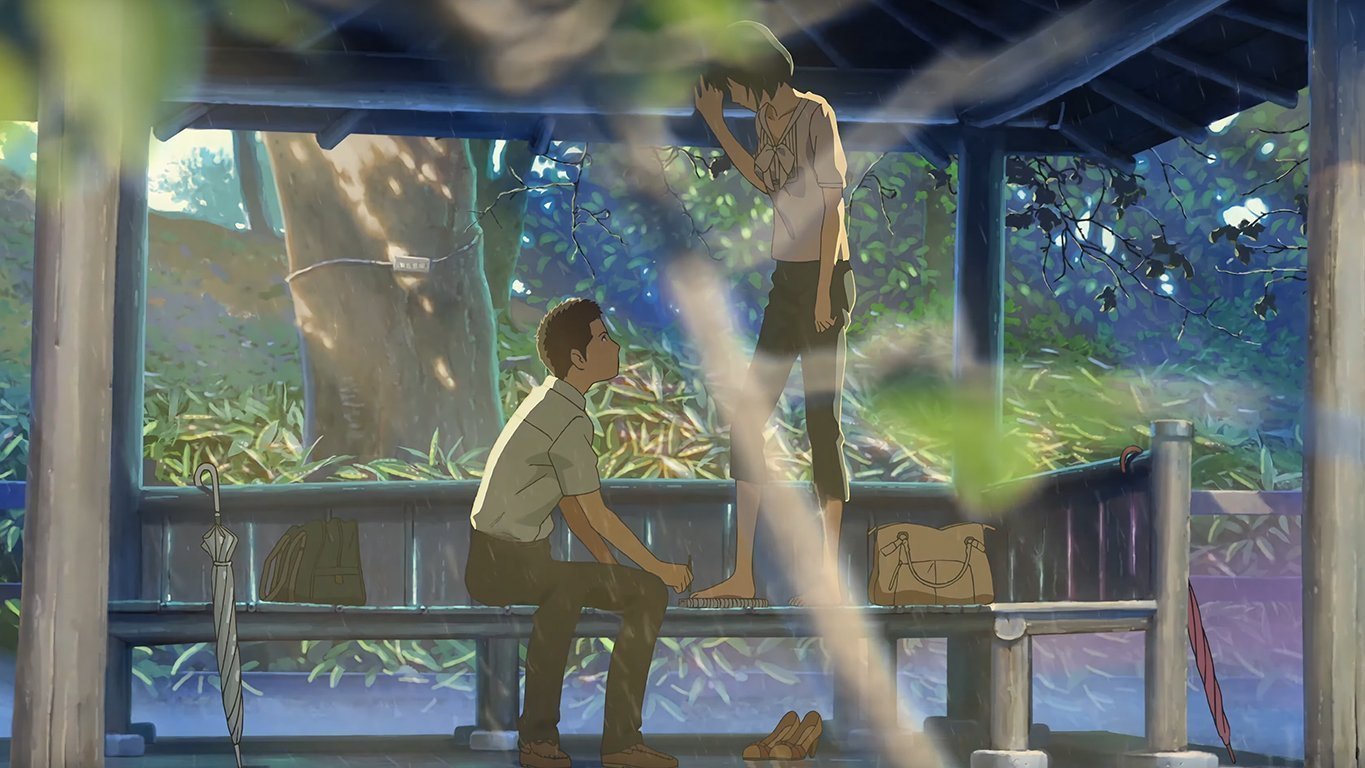
The Garden of Words (Kotonoha no Niwa) is one of Makoto Shinkai’s shortest films, about 46 minutes long, and maybe one of his most beautiful. Almost everything happens in a Tokyo garden, in the rain, between two people who are not quite sure where to go.
In this article I tell the story, explain who Takao and Yukari are and what, for me, the film is trying to say. Heads up: there are spoilers for the ending from here on.
The story of The Garden of Words
Takao Akizuki is 15 and has a dream that does not fit school very well: he wants to make shoes. On rainy days, instead of going to his morning classes, he goes to Shinjuku Gyoen, a large garden in the middle of Tokyo, and spends his time sketching designs in his notebook.
On one of those days, in the garden’s shelter, he meets a woman drinking beer and eating chocolate at nine in the morning. She is Yukari Yukino, 27. At first they talk about nothing important, but they start meeting there every rainy morning of the season.
Without ever asking each other’s names, they slowly open up. Takao tells her about his dream and measures her foot to make her a shoe. Yukari, who says she has “forgotten how to walk”, seems to find in him a reason to keep coming back to the garden.
About the film
- Original title: Kotonoha no Niwa (言の葉の庭)
- Written and directed by: Makoto Shinkai
- Studio: CoMix Wave Films
- Released in Japan: 2013
- Running time: about 46 minutes
- Theme song: Rain, sung by Motohiro Hata
Who is Yukari?
The big twist is finding out who she is. Yukari teaches classical Japanese literature at Takao’s own school. She is skipping work too: after a rumor spread by students, she was harassed and could no longer bring herself to walk into the classroom.
The stress even took away her sense of taste. That is why the only things she can taste are chocolate and beer. For her, the garden is not a stroll in the park: it is the only place where she can stay on her feet.
So the two of them are there for the same reason, each in their own way. He runs away from school so he will not give up on his dream. She runs away from school because the adult world became too heavy.
The Man'yōshū poem
At their first meeting, Yukari says goodbye by reciting a tanka, a short Japanese poem. Takao does not understand it at the time. Only later, leafing through his classical literature textbook, does he find out that the poem comes from the Man’yōshū, the oldest anthology of poetry in Japan, more than 1,200 years old.
Her poem speaks of distant thunder and a cloudy sky: if it rains, maybe you will stay here with me. When Takao finally answers, with the next poem in the anthology, his reply is: even without rain, I would stay, if you asked me to.
This is where the title makes sense. In Japanese, kotonoha means “words”, but it is written with the characters for “leaves”. The garden of words is the place where the two of them say, with poems and silences, what they cannot say any other way.
The rain is not just the backdrop. In the film, it is the excuse that lets two lonely people find each other.
What happens at the end?
When the rainy season ends, the meetings stop. On the last day of rain, the two of them get soaked and go to Yukari’s apartment. Takao tells her he loves her. She answers that he should call her “teacher”, the way a student talks to the person who teaches him, and tells him she is going back to her hometown in Shikoku.
He leaves hurt, she runs after him down the stairs, and that is where the two of them finally tell the truth: she says that, on those mornings, he was the one saving her. It is one of Shinkai’s most powerful scenes, and nobody has to kiss anybody.
In the end, Yukari goes back to teaching in Shikoku and the two of them write letters to each other. Months later, in winter, Takao returns to the garden with the shoe he made for her finished and decides he will keep walking until he can go and see her. The film ends there, open.
What is the film's message?
A lot of people sum up The Garden of Words as a love story between a student and a teacher. For me, it is more than that. It is a film about two people who were standing still, each one stuck in their own fear, and who learned to walk again because of each other.
There is something I find very honest about it: the film does not pretend that the age gap and their situation do not matter. It does not end with a couple. It ends with two paths that move on, and with a shoe, which is exactly what helps someone walk.
And it leaves a lesson for anyone with a slightly unusual dream, like making shoes or writing books: sometimes we need a place where nobody expects anything from us, and someone who tells us the dream is worth it.
Other films by Makoto Shinkai
The Garden of Words came after 5 Centimeters per Second and before Your Name. If you liked it, check out my list of must-see Makoto Shinkai films and, if you have questions about his most famous film, I explain everything in Does Your Name have plot holes?.
A fun fact: Yukari, the teacher, makes a brief appearance in Your Name, teaching classical literature to Mitsuha.
Frequently asked questions
Are The Garden of Words and Kotonoha no Niwa the same film?
Yes. The Garden of Words is the English title and Kotonoha no Niwa is the original Japanese title.
How long is The Garden of Words?
About 46 minutes. It is a medium-length film, short enough to watch during a break in your day.
Do Takao and Yukari end up together?
Not in the film. She goes back to Shikoku, they write letters to each other and Takao decides to keep moving forward until he can go and see her. The ending is open.
Is the garden in the film real?
Yes. It is Shinjuku Gyoen, a national garden in Tokyo, and the shelter from the scenes is there too.
Keep reading
What about you? Have you ever had a place of your own to escape to when everything felt too heavy? Tell me in the comments.